Blog

AI Slop Is In The Eye Of The Beholder

AI is changing how marketers create content, but does using AI automatically make something AI slop? Explore LinkedIn’s approach to AI content, the truth behind the 40% reach reduction claim, and how B2B marketers can create content that feels authentic, valuable, and human.
Category Blog
Date 10.06.2026
Author Aleisa
Services Paid Social

Do you know what AI Slop is? Nobody has really defined exactly what it is, but that doesn’t mean marketers can ignore it.

AI has quickly become a tool regularly used by marketers to research, write, edit and create content. While simultaneously, platforms like LinkedIn, are introducing new ways for users to identify (and report) content they believe was created by AI.

But here’s the thing, for over two years, LinkedIn had an “enhance your post” option they pushed on their users, only to retire that option in July 2026, offer a proofreader in its place, and simultaneously add a “seems like AI slop” option to its post report menu.
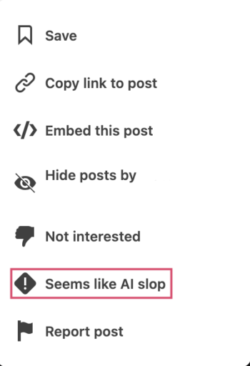
Seem like AI Slop

Since this all happened, there has been a lot of discussion about what this means for marketers and how it could impact reach, with a specific claim beginning to circulate saying that LinkedIn is reducing the reach of AI-written content by 40%.

There’s just one problem with that claim: that’s not what LinkedIn actually said.

So, what is AI slop, how is it being identified and what should B2B marketers actually be doing about it?

What is AI Slop?

The short answer? There isn’t one universally agreed upon definition.

LinkedIn Chief Product Officer, Hari Srinivasan, has acknowledged that defining AI slop is difficult and the definition continues to change. Which is part of the reason why LinkedIn introduced the feedback option in the first place. Utilizing user feedback to help understand what content people consider to be low-quality or AI-generated. 

That means AI slop isn’t simply: Content written by AI = AI Slop

AI is multifaceted and can be used to brainstorm, edit existing content, improve grammar, summarize information or even help structure a post. So, when we’re talking about “AI slop,” there are really two different questions we should be asking:

  1. Was AI involved in creating this content?
  2. Does this content feel generic, repetitive or low quality?

To be clear, these are two different things and they don’t necessarily go hand-in-hand.

What LinkedIn Actually Said About the 40% Reduction

In an August progress update, Srinivasan said that more than 1 million members had used LinkedIn’s AI slop feedback option. He also said that members were seeing roughly 40% fewer views of content LinkedIn’s classifiers identified as slop.

That does not mean that LinkedIn automatically reduces your post’s reach by 40% because you used AI to write it.

The 40% figure relates to content that LinkedIn’s systems classify as slop and how that content is distributed.

There is a real distribution impact, but LinkedIn hasn’t published a blanket statement saying: “If you use ChatGPT or other AI tools to write your LinkedIn post, we’ll reduce its reach by 40%.”

Actually, LinkedIn has continued to say that using AI to assist with writing is acceptable, as long as the content represents the creator’s own voice.

So, if the use of AI isn’t necessarily the problem, what is?

Why AI Detection Doesn’t Tell the Whole Story

It seems like every day there is a growing number of tools claiming to identify AI-generated or AI-assisted content.

The challenge is that they don’t all measure the same thing.

For example, Pangram looked at LinkedIn posts longer than 250 words that it identified as fully machine-written and found that 41% of the posts it analyzed met that criteria.

Originality.ai analyzed 5,000 public LinkedIn posts and looked for evidence of AI involvement in posts over 100 words. Using its methodology, 81% showed more than moderate AI involvement.

Those are very different numbers. But that doesn’t necessarily mean one is wrong because they were asking different questions.

One was looking for posts that appeared to be fully AI-written, while the other was looking more broadly at evidence of AI involvement.

This is an important distinction for marketers because an AI detection score doesn’t automatically tell you:

  • Whether AI wrote the entire piece
  • Whether AI was only used for editing
  • Whether the content is actually low quality
  • Whether the content is factually accurate
  • Whether the content sounds like the person who published it

So, net: AI detected does not automatically equal AI slop.

Where is the Biggest Risk for B2B Marketers?

While there isn’t a single formula or set of rules that identify AI slop, there are a few areas where B2B marketers should pay close attention to.

Ghostwritten Executive Content

Executive thought leadership is one area where AI can create problems if it’s used to produce content at scale without enough human review and input.

For example, imagine five executives at the same company all use the same prompt: “Write a LinkedIn post about the importance of AI in B2B marketing.”

Even if the posts are technically different, they may have similarities in:

  • Hooks
  • Sentence structure
  • Vocabulary
  • Content formats
  • CTAs
  • Overall messaging

Again, the problem isn’t necessarily that AI was involved. The problem is that the content begins to sound like it could have been written for anyone, versus being written specifically by or for that individual.

False Positives

Another potential issue is false positives.

AI detection tools look for patterns in writing. But predictable writing doesn’t necessarily mean it was AI-generated.

For example, someone who writes in a very formal style, someone who is writing in a second language or someone who has developed a very consistent writing style, could create content that to a classifier, appears to be predictable and AI-influenced.

Meaning, that a piece of content could be flagged even when a person who created it didn’t use AI to generate it.

We actually tested this on a piece of content written in 2014 and it was flagged as AI-written. Interesting, since AI wasn’t an option then. Additionally, in July of 2026, we tested 100% AI generated content that was deemed to be human written. Neither of these claims were accurate, yet people take the outputs given by these tools as fact.

AI detection tools are constantly evolving, and should be used sparingly and with a healthy skepticism. And marketers shouldn’t just assume that an AI detection score is a definitive measure of whether something was created by a human or AI.

User-Reported Content

LinkedIn’s approach to identifying AI slop also puts some of the classification process in the hands of its users. Since its launch, more than 1 million members have used the AI slop feedback option.

That’s a lot of feedback. But it also means that each user is making their own judgement about what they feel qualifies as AI slop.

One person might report a post because it appears to obviously be AI-written, while another might report a post because the content feels generic, and another might report a post because they just don’t agree with what the poster shared.

So marketers need to recognize that “AI slop” isn’t a perfectly objective category or flag. Right now, it truly is in the eye of the beholder.

Is AI-Assisted Content Still Okay?

This is probably one of the most common questions we’re seeing on this topic and most platforms have made an important distinction between using AI to help with content and using AI to create the entire piece.

And while there isn’t anything inherently wrong with utilizing an AI tool, the challenge is that the line between “AI-assisted” and “AI-generated” is becoming harder to define.

Should You Try to Make Your Content “Undetectable?”

We wouldn’t recommend it.

As AI detection tools change and evolve, so will the tactic people will use to try to avoid being flagged by it.

So, instead of trying to write content that passes a particular AI detector, focus on creating content that provides real value.

How to Create Better AI-Assisted Content

There’s nothing wrong with using AI as part of your content writing process, but there are a few things you can do to help.

  • Use Your Own Data & Experiences: This gives the content something that a generic AI-generated post doesn’t have: information and data specific to you and/or your company.
  • Fact Check Everything: AI isn’t perfect and just because an AI tool includes a statistic, claim, source, date, information, etc., doesn’t mean it’s accurate.
  • Give Posters Their Own Voice: Don’t use one generic prompt for everyone. Build prompts and content around the individual to show they are unique individuals. Not someone who knows how to use AI.

Key Takeaway

AI isn’t automatically the problem.

The bigger problem is generic, repetitive, unsupported content, or content that doesn’t add any value to the person reading it.

Instead of focusing on whether or not AI was used in any capacity in creating a piece of content, focus on whether the content:

  • Provides a useful answer
  • Includes original information
  • Represents a real point of view
  • Contains specific examples
  • Sounds like the person/company publishing it

AI can help get content created faster, but it shouldn’t be solely responsible for creating the reason people should care about a piece of content.

In Conclusion

AI is becoming a bigger part of the content creation process, at the same time platforms are building more ways to identify and classify AI-generated and AI-assisted content.

That doesn’t mean marketers should stop using AI, it means that the way AI is utilized should be intentional.

Rather than trying to make AI-generated content look human or trying to beat the latest AI detector, focus on giving whatever AI tool you’re using, better, more detailed material to work with.

Because the easiest way to create content that doesn’t feel like AI slop isn’t to figure out the perfect prompt. It’s to have something worth saying in the first place.


About Obility

We have one purpose: help B2B companies generate demand and increase revenue through online marketing. Located in Portland, Oregon and founded in early 2011, we’re a fast-growing agency with a global client base ranging from early stage start-ups to multinational enterprises. Our focus is on B2B companies and we’re proud that our growth has been due primarily to client referrals.

Services