To do search terms correctly takes hours per month. To not do them is disastrous.
At this point Google treats exact match like it once treated phrase match, and phrase match can mean anything tangentially related. Advertisers lose significant budget to crap search terms, often without noticing. Consistent review of the actual search terms triggering impressions is hugely important for anyone running paid search campaigns.
Digging through search terms, checking search results to determine if it is relevant enough to target, adding new keywords, and adding negatives is a time-intensive process. On average I’d expect four hours per month to be spent on reviewing search terms with significantly more time put in when a new account structure or campaign is launched.
LLMs Can Significantly Speed Up the Process
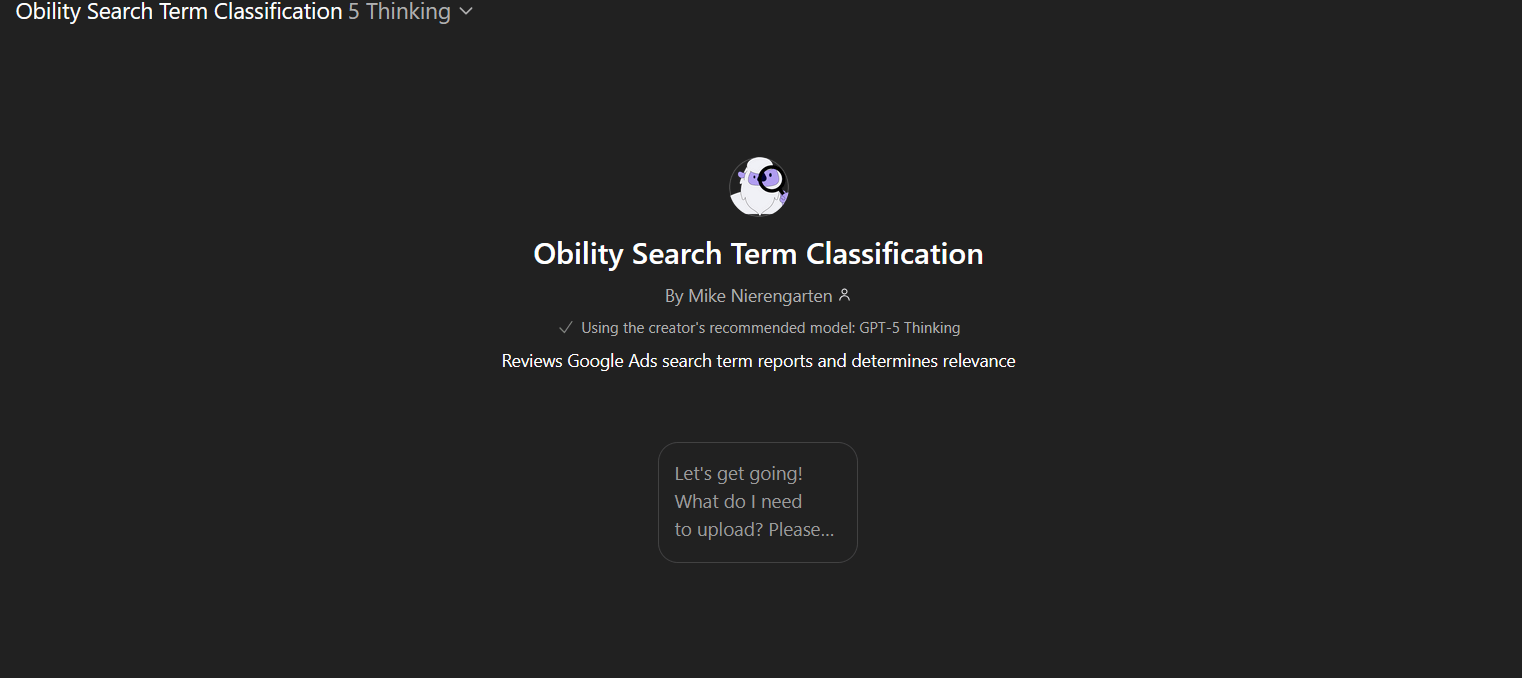
Large language models are not amazing at many things, but reviewing large data sets is one thing they excel in. Comparing search terms to target keywords and determining relevance is a process where Obility has recruited the help of ChatGPT by creating CustomGPTs.
The first CustomGPT focuses on semantic classification, review and scoring semantic relevance between a search term in an ad group with the target keywords in the same ad group. Because relevance is, well, relative, Obility gave specific criteria to the CustomGPT’s evaluation process. Some examples:
- Exact synonyms: Terms mean the same thing with identical functionality (e.g., “appointment scheduler” ↔ “appointment booking tool”)
- Direct variations: Singular/plural, verb/noun forms of same function (e.g., “schedule appointments” ↔ “appointment scheduler”)
- Functionally identical: Different words for the exact same action/product (e.g., “meeting booking software” ↔ “meeting scheduler”)
- User intent match: Searcher wants to accomplish the exact same task and would convert on the same offer
- Feature-level match: Terms describe the same core functionality (e.g., “automated meeting scheduling” ↔ “meeting scheduler”)
- Commercial equivalence: Terms indicate the same customer need, problem, and solution type
We also provided clear directions on where search terms are not semantically relevant:
- Different workflow stage: Related but different step in process (e.g., “meeting planner” [finding time] vs “meeting scheduler” [booking time])
- Tangentially related: Connected topic but different action (e.g., “meeting agenda templates” vs “meeting scheduler”)
- Adjacent functionality: Related feature but different primary function (e.g., “availability checker” vs “meeting scheduler”)
- Broader category: Terms too broad that include but aren’t focused on the target (e.g., “productivity software” vs “meeting scheduler”)
- Narrower subset: Terms that are too specific for the target (e.g., “doctor appointment scheduler” vs generic “meeting scheduler”)
- Different intent stage: Information seeking vs transaction (e.g., “how to schedule meetings” vs “meeting scheduler”)
- Competitor/brand: Specific brand names when evaluating generic terms
- Related but distinct tools: Same domain but solves different problem (e.g., “calendar sync” vs “meeting scheduler”)
This has allowed us to create a tool that can quickly gauge relevance:
Obility Search Term Classification GPT: https://chatgpt.com/g/g-68e4346818288191af08feedabc45b23-obility-search-term-classification
The second GPT is all about finding root negative keywords to add to campaigns. Simply excluding all irrelevant keywords would quickly eat up Google’s 10,000 max negative keywords per campaign. We need to find root words that block multiple irrelevant search terms.
The Broad Match Negative Keyword GPT reviews all of the irrelevant keywords flagged in the first GPT and breaks them down into individual keyword tokens. The LLM then compares those tokens with existing target keywords to make sure we are not blocking any target keywords we would like and then provides a list of negative keywords for the team to review and quickly upload to our clients’ campaigns.
Obility Broad Match Negative Keyword GPT: https://chatgpt.com/g/g-68e435b241c081919944c15bd0c3961f-obility-broad-match-negative-keyword-gpt
I’d also like to give a shout out to SpyFu’s customGPT that can analyze search terms and let you know if your competitor is targeting them. This provides an extra data point on whether or not a search term is relevant to your business.
As Always, Be Careful with Data
As part of the CustomGPTs, we wanted to warn advertisers before putting in their branded campaigns. Ideally, you aren’t telling ChatGPT too much information about yourself or your company. By removing any reference to your brand, you can get search term classification and negative broad match keywords without training ChatGPT on your spend.