SaaS

The AI Search Footprint: What it Takes to Get on Claude’s B2B SaaS Shortlist

Hitting nearly 12,000 searches, running 150-450 prompts per SEO client later, we've uncovered what goes into Claude's AI Search footprint and what it takes for B2B SaaS brands to get considered. We did the heavy lifting, analyzing how Claude researches software vendors, builds its shortlists, compares solutions, and determines which brands make it into its final recommendations. Our findings provide a closer look at what happens behind the scenes, why some brands get considered while others are overlooked, and what B2B marketers can do to identify gaps and improve their AI Search visibility.
Category Resources Library
Date 10.28.2026
Author Mike N.
Services Generative Engine Optimization (GEO)

Showing up in Claude is one thing. Getting considered when a buyer is researching software is another.

According to a 2026 Gartner Survey, 45% of B2B buyers used generative AI during a recent purchase to gather information on vendors and products. The same survey found that 51% of buyers expect to run into misleading information from generative AI. We analyzed how Claude researches B2B SaaS vendors by tracking its initial queries, vendor shortlist criteria, and information requirements before recommending a product.

So we collected 150-450 prompts for each SEO client and ran over 12,000 queries through Claude and tracked its searches, the URLs it reviewed, and its stated reasoning.

We call this the AI Search Footprint: the when, what, and why behind how Claude researches and shortlists B2B SaaS vendors.

The AI Search Footprint: Key Findings at a Glance

  • Getting researched matters: Throughout the tested industries, brands Claude searched for by name appeared in 86% to 100% of final answers, compared with 7% to 52% for brands it never searched for by name.
  • Claude starts with a shortlist: Vendor lists made up 47% of its first searches, while only 10% looked up a single vendor.
  • Not every prompt triggers a search: Claude answered 22% of prompts using its existing training data without searching for additional information
  • Industry requirements influence research: Claude frequently added requirements such as FedRAMP, HIPAA, and CMMC, even when buyers hadn’t explicitly mentioned them
  • Claude looks for ways to compare vendors: 13% of searches included “vs” or “alternatives,” and 9% included pricing terms

AI visibility is directly tied to understanding how Claude researches your category, which vendors it considers, and what information shapes its choices.

Getting on the Shortlist Matters More Than You Might Think

One of the biggest findings: across the industries we tested, brands Claude searched for by name appeared in 86% to 100% of final answers. Brands it never searched for by name appeared in just 7% to 52%.

Those are ranges covering the industries in our study.

If Claude never gets around to researching your brand, your chances of appearing in its final answer are significantly lower.

AI visibility measures whether Claude considers your brand in its initial research, not just whether your name appears in the final response.

So, how does a vendor get on that shortlist?
Claude Starts Broad, Then Gets Specific

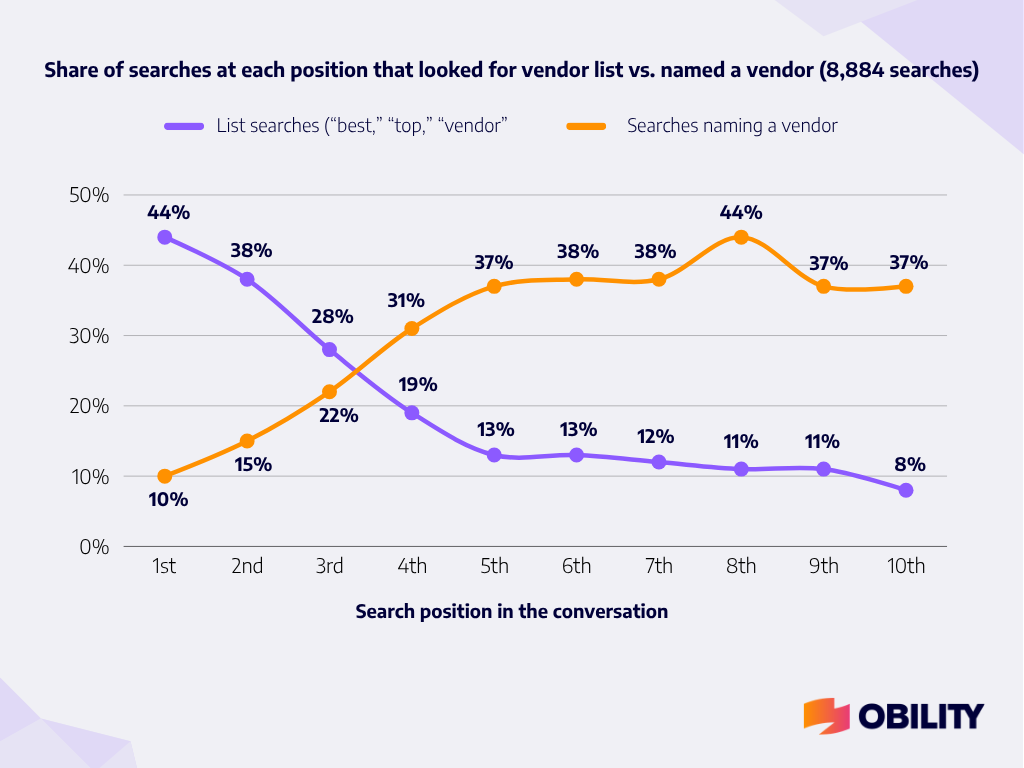
47% of Claude’s first searches looked for vendor lists using terms like “best,” “top,” or “leading”, while only 10% looked up a single vendor.

As the conversation progressed, the pattern changed. By the eighth search, 40% of searches named a single vendor as Claude dug deeper into pricing, features, industry fit, and technical requirements.

Claude avoids suggesting a single vendor in response to a prompt, because out of thousands of conversations, Claude named a single vendor only five times.

Claude compares capabilities between multiple vendors to shape its answer without picking a single winner.

If your brand isn’t making it into the research process, you may be missing an opportunity before the final recommendation even happens.

AI Search Footprint - share of searches at each position that looked for vendor list vs named a vendor

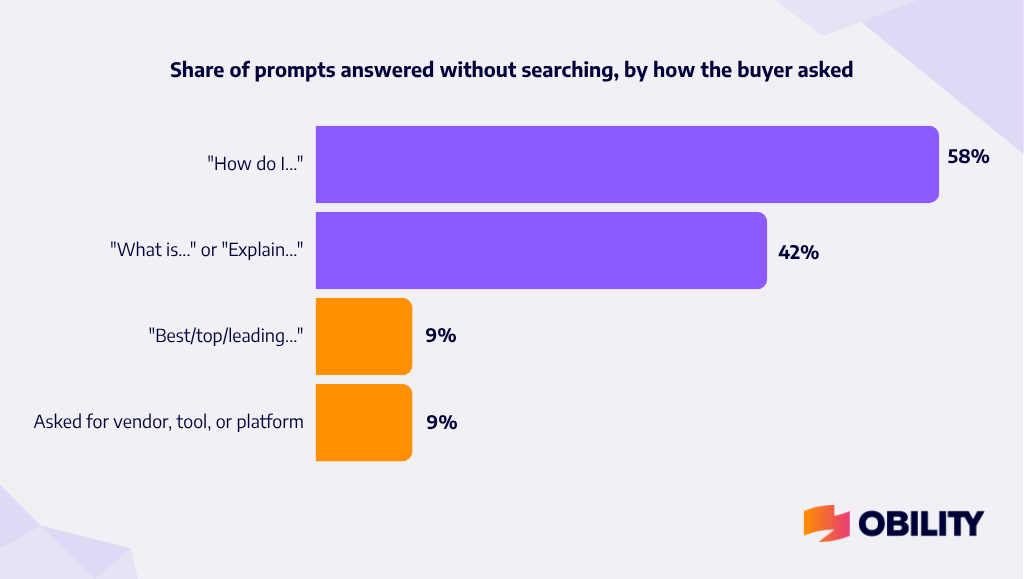
We also found that Claude answered 22% of the prompts in our study using its existing training data without searching for additional information.

The way a question was phrased made a difference too.

AI Search Footprint - Share of prompts answered without searching, by how the buyer asked

For example, Claude answered 58% of “How do I…” prompts without searching. For “What is…” or “Explain…” prompts, that number was 42%. When prompts asked for the “Best,” or “Top” vendors, or requested a tool or platform, only 9% were answered without a search.

That signals a change in how to think about content.

Educational content still matters, but a how-to guide may not be enough to get your brand considered when someone is evaluating software. Claude might answer an information question from memory without ever visiting your website.

It’s also important to look at the content supporting the entire buying process. For example, if you publish a guide on how to evaluate EDI vendors, consider also creating a comparison page, that helps buyers compare EDI vendors based on their needs.

You want content that supports the buyer at different stages, not just content that answers the first question they ask.

Claude Adds Requirements Buyers Never Asked For

Claude doesn’t always stick to the exact wording of a prompt. In our study, it often introduced industry-specific requirements based on what it believed the buyer needed.

A few examples:

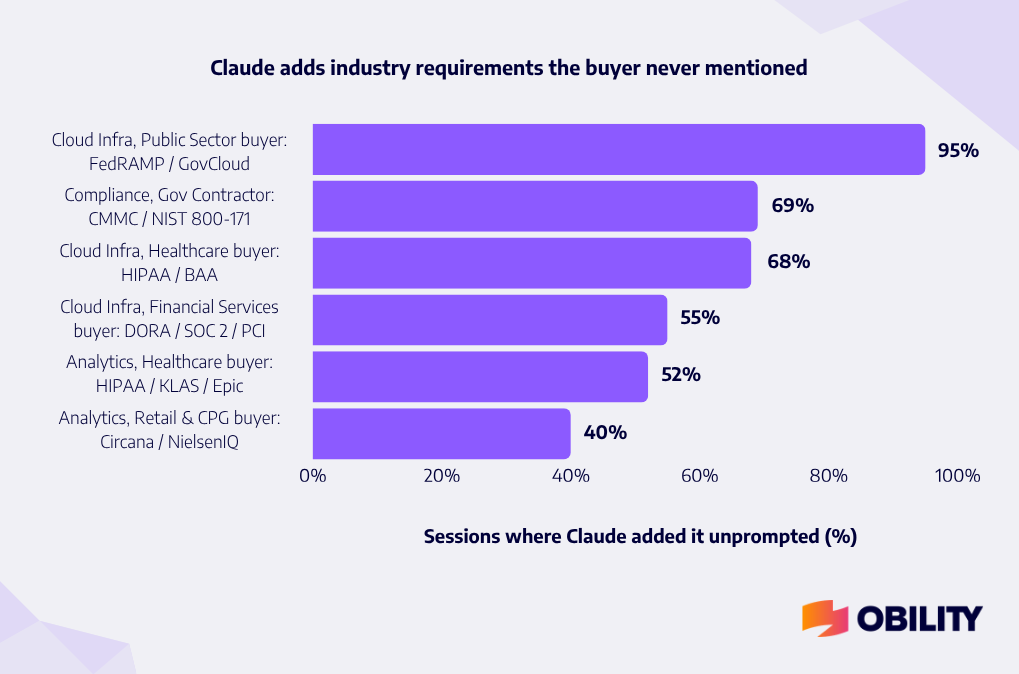
  • Public-Sector Cloud Infrastructure: Claude added FedRAMP, GovCloud or StateRAMP requirements in 20 of 21 conversations
  • Healthcare: Claude added HIPAA or BAA requirements in 15 of 22 conversations
  • Government Contractor Compliance Software: Claude added CMMC or NIST 800-171 requirements in 11 of 16 conversations
AI Search Footprint - Claude adds industry requirements the buyer never mentioned

These details can influence which vendors and webpages Claude considers relevant.

If you sell to healthcare organizations, your content should clearly address the requirements those buyers care about. The same goes for public-sector organizations, government contractors and other specialized industries.

A generic industry landing page probably isn’t enough. Your content needs to explain the relevant standards, certifications, integrations, and technical requirements in a way that makes them easy to find and understand.

A certification badge tucked into your footer doesn’t provide the same context as a page that clearly explains your compliance capabilities.

Claude Is Comparing Vendors, Too

Once Claude starts researching individual vendors, it’s looking for information that helps distinguish one option from another. And it doesn’t always wait for the buyer to explicitly ask for a comparison.

In our study, 13% of searches included “vs” or “alternatives,” while 9% included pricing terms.

That means comparison and pricing information can become part of the research process even when the original prompt doesn’t specifically ask for it.

If Claude is trying to figure out how your product compares with another solution, will it find information on your website? Or will it have to rely on someone else to explain the differences?

Comparison pages, alternatives pages, clear pricing information and FAQs covering integrations, deployment options, and usage limits can help answer those questions.

You don’t need to publish a page for every possible search variation. But you should understand what buyers are likely to ask as they narrow down their options and make sure your website provides useful answers.

Use the AI Search Footprint to Find Your Gaps

AI visibility tools can tell you whether or not your brand appears in responses to certain prompts. That’s useful information, but it doesn’t explain why you’re visible for one prompt and missing from another.

That’s where the AI Search Footprint comes in.

By looking at the searches Claude runs, the URLs it reviews, and its stated reasoning, you can identify what’s helping your brand get considered and where you’re missing opportunities.

Maybe Claude is building vendor lists and your brand isn’t included. Maybe your competitors have comparison pages that answer questions your website doesn’t. Or maybe your content mentions an industry but doesn’t address the technical requirements Claude is searching for.

The right opportunities depend on your category and how Claude researches it. The point is to understand what is happening before deciding what to change.

Want to Understand Your AI Search Footprint?

Our AI Search Footprint study breaks down what we learned from over 12,000 queries using B2B software buying prompts for our SEO clients, including how Claude builds shortlists, researches vendors, and identifies industry-specific requirements and what marketers can do with that information.

Read the full study to explore the findings and see how Claude’s research process could affect your brand.


About Obility

We have one purpose: help B2B companies generate demand and increase revenue through online marketing. Located in Portland, Oregon and founded in early 2011, we’re a fast-growing agency with a global client base ranging from early stage start-ups to multinational enterprises. Our focus is on B2B companies and we’re proud that our growth has been due primarily to client referrals.

Services