Resources Library

The Thought Leadership Playbook for B2B Marketing Teams

A 5-step framework for using LinkedIn thought leadership to build awareness and visibility on the platform and in AI search. I'll discuss how to rank for your target keywords in AI search, build generative engine optimization (GEO) and AI search visibility, and run the kind of Thought Leader Ads that put your brand in front of buyers who can't ignore it.
Thought Leadership Playbook
Category Resources Library
Date 05.01.2026
Author Emily Paxton
Services Generative Engine Optimization (GEO), Paid Social

I audited four executive LinkedIn profiles against their company’s priority keywords for AI search visibility. What I found was uncomfortable to tell the exec team, but completely fixable.

Every exec was active on LinkedIn. Short posts, event recaps, the occasional reshare of company content. None of it was getting cited by AI tools. And AI tools are increasingly the first stop for B2B buyers researching vendors, evaluating categories, and shortlisting solutions.

Posting consistently and ranking for target keywords in AI search are two different things. Most exec LinkedIn programs aren’t built around either goal clearly. They sit somewhere in between, doing neither well. I’ll explain why both are important and how to execute a thought leadership strategy that gives your B2B brand the upper hand.

Why LinkedIn Thought Leadership Is Now an AI Search and GEO Ranking Signal

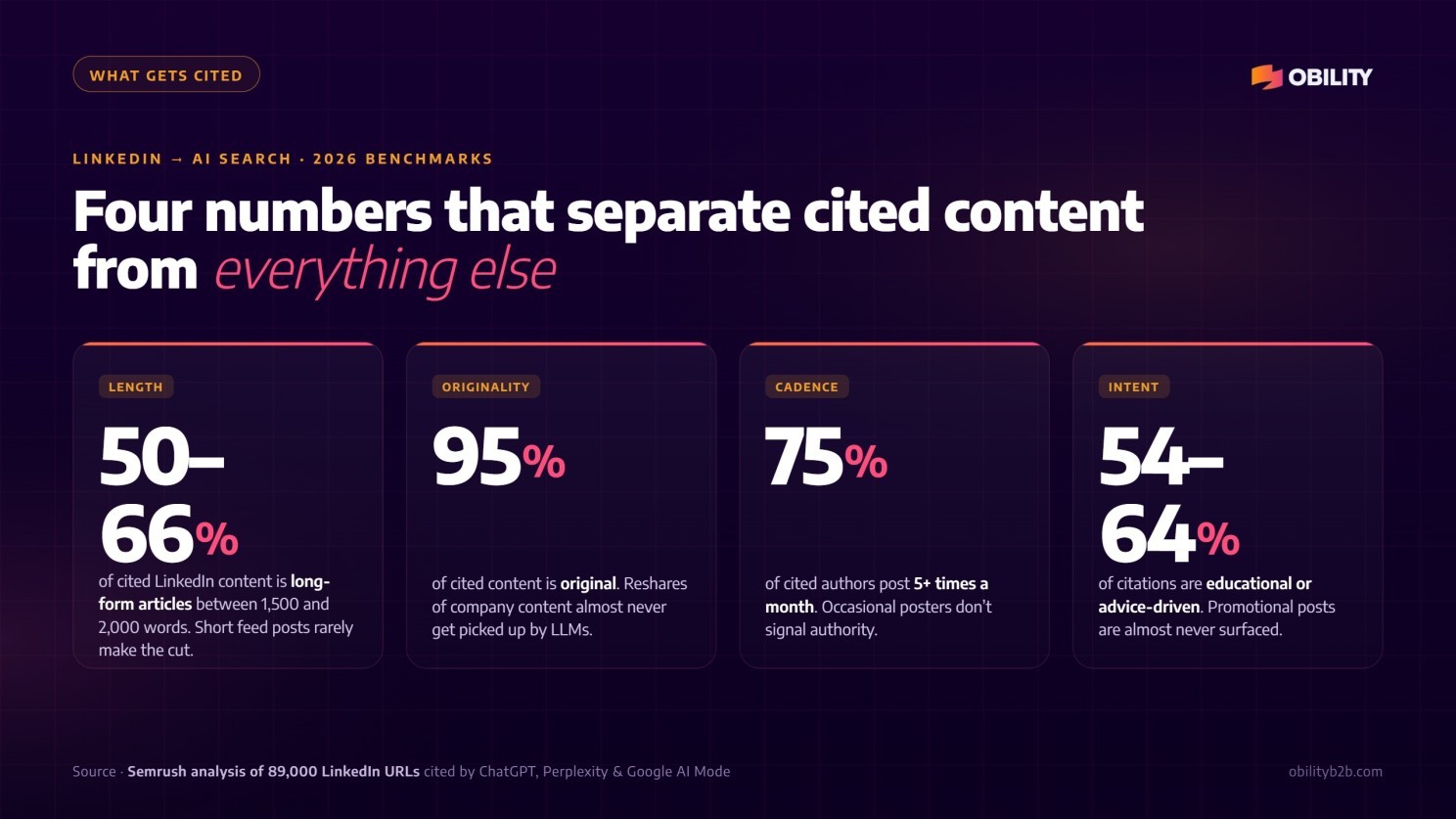
According to Semrush research analyzing 89,000 LinkedIn URLs cited by ChatGPT, Perplexity, and Google AI Mode, LinkedIn is the second most cited domain by LLMs in 2026, appearing in 11% of AI-generated responses. Only Reddit ranks higher.

But what gets cited on LinkedIn is very specific:

• Long-form articles between 1,500 and 2,000 words account for 50-66% of all cited LinkedIn content. Short posts rarely make the cut.
• 95% of cited content is original. Reshares almost never get cited by AI tools.
• 75% of cited authors post five or more times per month. Occasional posters are rarely picked up.
• Educational and advice-driven content accounts for 54-64% of citations. Promotional posts are almost never surfaced.

Most B2B exec LinkedIn strategies are built entirely around the things that don’t get cited. Things like short posts, company reshares, event announcements, a personal story or career learning.

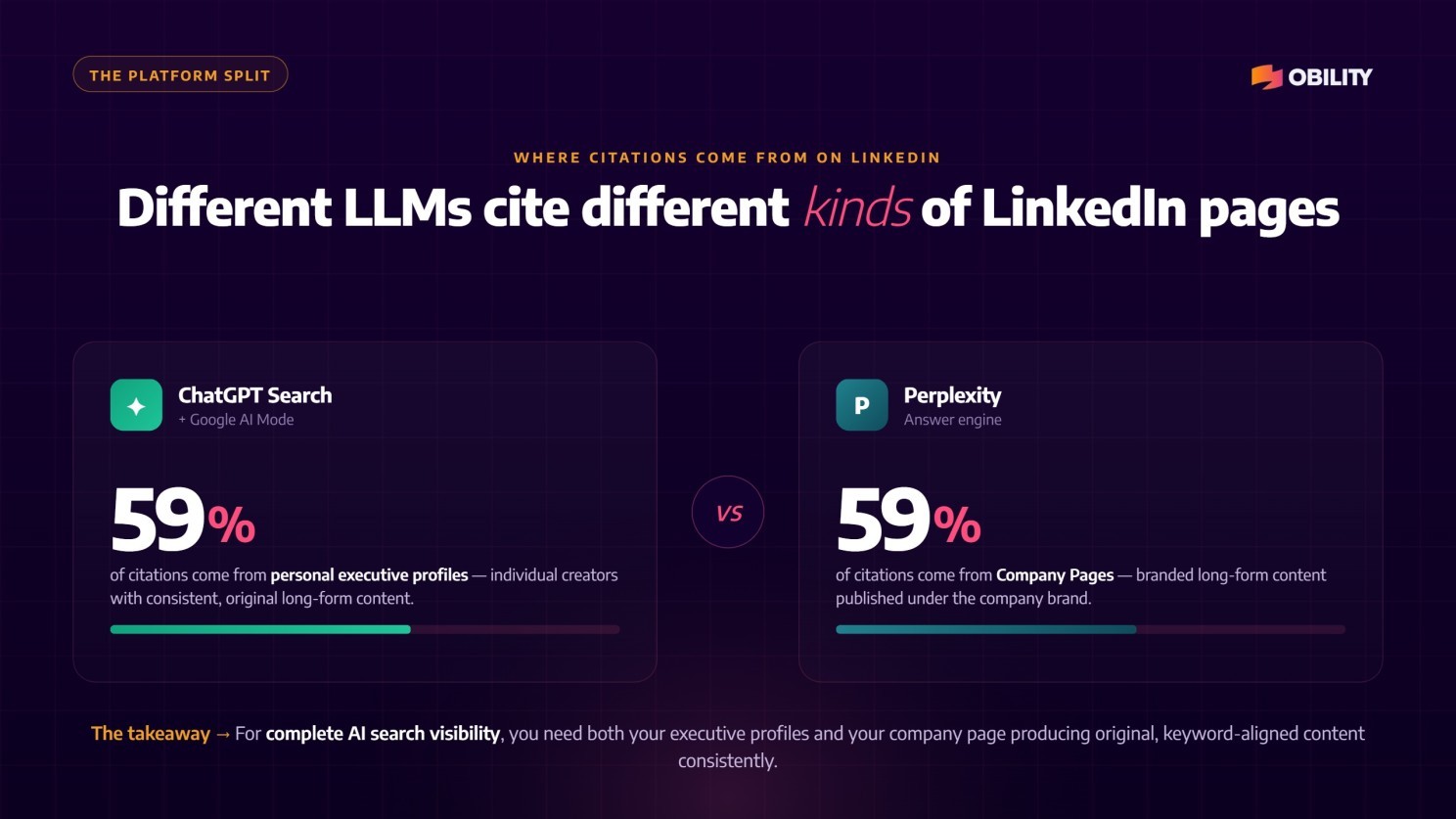
There is also a platform split worth understanding. ChatGPT Search and Google AI Mode favor individual creators, with 59% of citations coming from personal profiles. Perplexity favors Company Pages at the same rate. For complete AI search visibility across all major LLMs, you need both your executive profiles and your company page to produce original, keyword-aligned content consistently.

LinkedIn’s algorithm applies relevance, expertise, clarity, and early engagement, to all content types, posts and articles alike. For AI search visibility, articles carry more weight because they stay indexed and discoverable long after a post’s distribution window closes.


The Two-Track Strategy: Ranking Content and Thought Leader Ads

Before getting into the five steps, it helps to understand that an effective executive LinkedIn program runs two parallel tracks. They serve different purposes and require different content formats.

The first track is content for ranking. This means long-form LinkedIn articles of 1,500 to 4,000 words. Publish this content on the brand website first. The reason the order matters is that Google and LLMs will generally treat the first indexed version as the primary source. If your blog publishes it first, your domain captures the SEO value. LinkedIn then adds a second citation surface, which is a benefit, not a problem. The LinkedIn version can be lightly reformatted. Break up long paragraphs, add a brief intro that frames it for a LinkedIn audience, and move any external links to the first comment. The core content stays identical. I tell clients to focus on repurposing content, and this is a great example of that. Post the highlights of your long-form article as a LinkedIn post (with the idea of turning this content into a Thought Leadership Ad). Distribute further by posting to your own subreddit or tweaking the content to fit an industry subreddit if relevant (note your content will surely need some finessing to do this, but it’s possible).

The second track is Thought Leader Ads. These are sponsored posts, not articles. They run two to five paragraphs and are built around contrarian takes, industry observations and data-backed insights. The goal is brand awareness, trust, and authority with your exact ICP, delivered at scale through paid targeting to your exact ICP. Nobody will read a 2,000-word post. The format that works for ranking content is the wrong format for paid distribution.

These two tracks compound each other. Your long-form articles build the GEO and SEO foundation. Your Thought Leader Ads put your exec’s voice and perspective in front of buyers before they are actively searching. By the time a buyer types a query into an AI tool and sees your content cited, they have likely already seen your exec in their feed through paid distribution. That combination is what makes a brand feel inevitable.

And, I should note here, your content doesn’t have to come from an executive. Your company probably has lots of folks who would be willing and wanting to create content. Executives tend to have larger followings, and are already actively posting, they just need direction on executing better.

Step 1: Map Your Target Keywords to the Right Executive

Not every executive should post on every topic. The most effective approach to executive LinkedIn AI search presence is assigning keyword clusters to individuals based on their actual role, expertise, and credibility on the topic.

Start by listing your 10-15 priority keywords for AI search. These are the terms your buyers use when researching your category, and the ones you are tracking for SEO and AI Search. Then map each cluster to the exec who can speak to it with genuine authority, data-backed statistics, and unique findings.

  • Your CEO might own category-defining industry thought leadership and big-picture trends.
  • Your CTO or technical lead might own product-related and technical proof point content, targeted around your core SEO keywords.
  • Your Chief Revenue Officer might own the commercial case for why customers choose you over alternatives, ROI, and pipeline impact.

The goal is for each exec to become the cited source when an AI tool generates an answer about their assigned keyword cluster. That only happens through individual-attributed, keyword-aligned, long-form articles published consistently.

Step 2: Audit Your Executive Team’s Current LinkedIn GEO Presence

Before building a content program, you need an honest read on where each exec stands against their assigned keywords.

For each executive, assess:

  1. Are they posting on their priority keywords at all, or are they drifting into adjacent topics that don’t map to anything your company prioritizes in SEO and AI Search?
  2. Are they publishing long-form articles (500-2,000 words) or only short feed posts? This is the most important format distinction for GEO visibility.
  3. How frequently are they posting? Once or twice a month will not signal the kind of authority that AI tools recognize.
  4. Do they have existing content, such as interviews, PR coverage, or podcast appearances, on their priority topics that hasn’t been republished as a LinkedIn article? This is the most common and most fixable missed opportunity.

At Obility, we built an executive LinkedIn scoring tool that audits each profile against a company’s priority keyword clusters and surfaces the gaps. When we ran it for a recent client, we found their CEO had strong content on their most important AI search topics sitting behind a third-party media wall, content that LLMs couldn’t index directly from LinkedIn. Less than 30 minutes of work to republish it as a LinkedIn article would fix that. Another client had a blog post on the company website go viral (awesome!), but forgot to distribute the content. This would have been amazing content for a LinkedIn article, thought leadership ad, and industry subreddit. I’ll say it again, redistribute that content!

Step 3: Publish Long-Form Articles Optimized for AI Search Keywords

This is the single highest-impact change most B2B exec teams can make for AI search and GEO visibility.

The publishing sequence matters. Publish the article on your company blog first. This gives search engines and LLMs a primary URL to index, one your company controls. Then repost it as a LinkedIn article. LinkedIn’s distribution adds reach and citation potential. Doing it in reverse, publishing on LinkedIn first, can limit the SEO value your own domain captures.

A 1,500-word article on a priority topic, written with keyword-rich headers, a direct answer near the top, and concrete proof points throughout, is dramatically more likely to appear in an AI-generated response than a short-form post on the same subject. The short form post ir your follow up, geared to be a thought leader ad.

Apply best practices specific to LinkedIn articles. Add a professional cover image and 2-3 inline images throughout the article body to break up text for mobile readers. Keep any external links out of the article body. LinkedIn reduces distribution for articles with outbound links.

Step 4: Build a Posting Cadence That Signals Topical Authority

Frequency is a real signal for AI search citation. 75% of cited LinkedIn authors post at least five times per month. Occasional posting, even if the content is strong, does not build the kind of consistent authority that AI tools recognize.

A practical cadence for each executive:

  • Two long-form articles per month (1,500-2,000 words) on a priority keyword cluster/industry topic directly connected to your company. This is the AI search anchor piece. Post to your brand blog first.
  • Four to six shorter original posts per month on topic. These should be original observations, data points, or takes, not reshares of company content.
  • Reshares do not count toward GEO. 95% of cited content is original. Resharing company posts contributes nothing to individual AI search citation volume.
  • Publish articles on Tuesday, Wednesday, or Thursday mornings for maximum engagement. Early engagement signals quality to LinkedIn’s algorithm and accelerates organic distribution.

Most exec teams cannot maintain this cadence without ghostwriting support or an internal driver creating a content calendar and supporting with content creation. That is not a criticism. It is just the reality for people running functions at scale. Building a content calendar with a ghostwriter who understands GEO best practices is worth the investment.

Step 5: Track AI Search Visibility, Not Just LinkedIn Engagement Metrics

Views, comments, saves, and reshares measure LinkedIn performance. They do not tell you whether your executives are getting cited in AI-generated answers for your priority keywords, which is the metric that actually maps to whether buyers are finding your brand during their AI research.

A GEO measurement framework for executive LinkedIn thought leadership tracks:

  • LLM citation tracking: how often exec articles appear in ChatGPT, Perplexity, and Google AI Mode responses for your priority keywordsAI Overview appearances for the keyword clusters assigned to each exec
  • Answer search referrals in GA4, traffic arriving directly from AI-generated answers
  • Share of voice in AI answers versus competitors for your top category topics

Without this measurement layer, you are optimizing without visibility into what is actually moving. LinkedIn engagement metrics will not tell you whether your exec team is building real AI search presence for the keywords that matter.

Thought Leader Ads: The Paid Distribution Layer

Once your executives are producing long-form ranking content, Thought Leader Ads give you a way to distribute their voice and perspective at scale, without waiting for organic reach to build.

Thought Leader Ads are sponsored posts run from an executive’s personal LinkedIn profile. They are not repurposed long-form articles. They run two to five paragraphs, maximum, and the format that performs is fundamentally different from the content you publish for ranking.

What works for Thought Leader Ads:

  • Personal stories or firsthand observations from the exec’s role and experience
  • Contrarian takes on a trend or assumption in your category
  • Industry or unique data paired with a pointed perspective on what it means
  • Honest reflections on decisions, mistakes, or lessons from building the business

The goal of a Thought Leader Ad is not to rank in AI search. It is to put your exec’s perspective in front of your exact ICP, build familiarity and trust, and make your brand feel present before a buyer is actively researching. LinkedIn’s targeting lets you serve these posts to a defined audience by title, company size, industry, and seniority, or even a targeted company list, so the impression lands with the right person.

Thought Leader Ads work because they do not read like brand ads. They come from a real person’s profile, in a format that matches organic content. When a prospect sees the same exec’s name and perspective multiple times in their feed, the recognition that builds is a direct input into how that buyer perceives your company when they eventually go searching for your solution.

The compound effect is what makes this worth investing in. A buyer encounters your exec’s opinion in a sponsored post, then weeks later asks an AI tool about your category and sees your brand cited in the response. That is not a coincidence they can explain. It just feels like your brand is everywhere.

Executive Thought Leadership Is One Layer of Building Inevitability

LinkedIn thought leadership doesn’t work in isolation. The goal is what we call at Obilty Building Inevitability: by the time your buyer is ready to evaluate vendors, your brand should already feel like the obvious answer. They should feel like they’ve seen you everywhere.

One touchpoint rarely closes a B2B deal. What wins is coordinated presence across every channel where your ICP is hanging out on their downtime, and where they spend their focus time researching, comparing, and deciding. When that presence is consistent and stacked across channels, your prospects start sensing that everyone in their space is talking about you. That’s not luck. That’s a system of influence.

Executive LinkedIn thought leadership is one layer of that system. Here’s how the channels compound:

  • Exec articles get cited in AI search and GEO, building unpaid visibility every time a buyer asks an LLM about your category. Those same articles become the creative foundation for LinkedIn Thought Leader Ads — letting you put exec content directly in front of your target ICP at scale without it looking like a brand ad
  • SEO and GEO best practices on your website ensure your company content is also being indexed and cited by AI tools
  • A Reddit organic strategy builds presence in the communities where buyers research vendors and competitors; Reddit is the number one cited domain by LLMs
  • YouTube content optimized for AI citation captures the 16% of AI-generated answers that now reference video
  • Paid search captures high-intent demand from buyers who are actively evaluating, the final piece that converts awareness into pipeline

The companies that build this kind of coordinated presence now are going to be very hard to displace in 12-18 months. The ones waiting are going to spend years catching up.

Want to Know Where Your Executive Team Stands?

At Obility, we help B2B companies build executive thought leadership programs optimized for AI search and GEO visibility, not just LinkedIn engagement. That includes keyword mapping, executive profile audits scored against your priority keyword clusters, ghostwriting support, LinkedIn Thought Leader Ad strategy, and the GEO measurement infrastructure to track what is actually moving the needle. Additionally, we provide traditional SEO and GEO/AEO/AI Search strategy.

If you want to understand where your exec team stands against your priority keywords, what is missing, and what to do about it, drop a comment. Happy to walk through what the audit surfaces and whether it makes sense for your team.

Obility is a B2B-only digital marketing agency specializing in Paid Search, Paid Social, SEO, GEO, Content, and Reddit. We work with B2B SaaS and tech companies from Series A through publicly traded enterprises, focused on opportunities, pipeline, and revenue.
Services